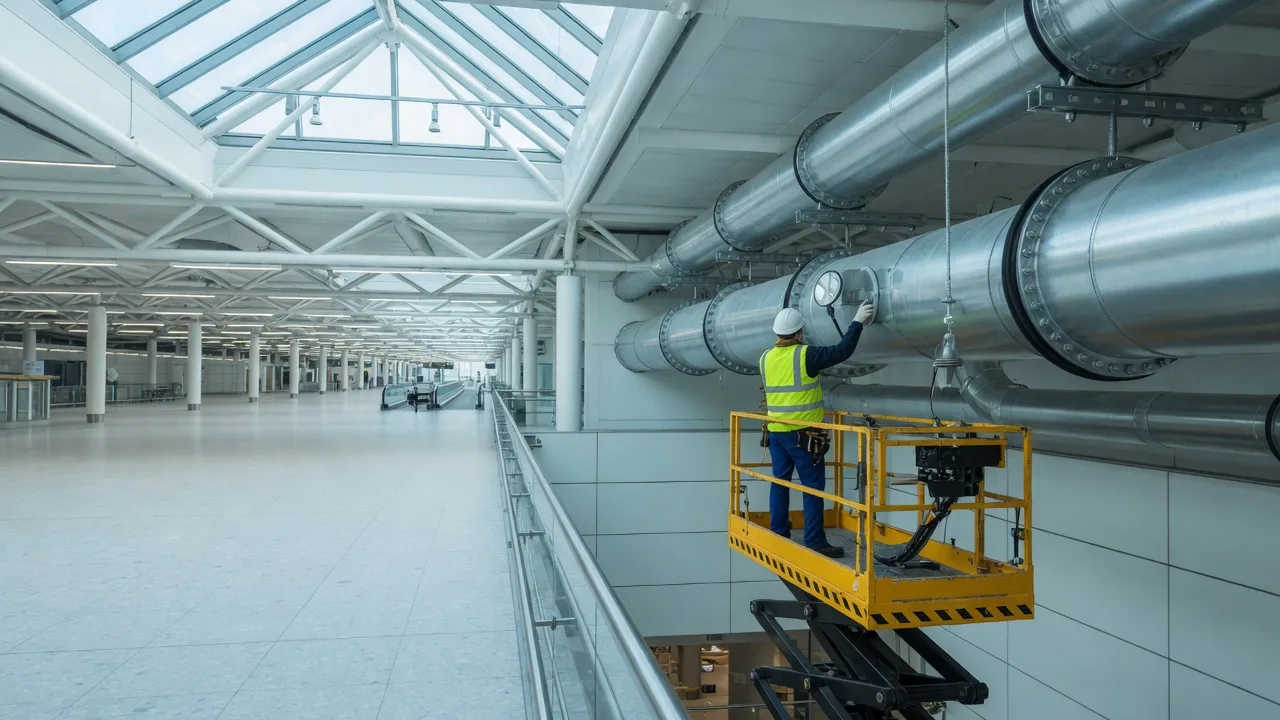
Airports Public & high-footfall
Ductwork, Ventilation and Fire Safety Services for Airports
Duct cleaning, kitchen extract, AHU maintenance and fire-damper testing for airport terminals and airside buildings.
Airports Public & high-footfall
Duct cleaning, kitchen extract, AHU maintenance and fire-damper testing for airport terminals and airside buildings.
Airports depend on ventilation that performs without interruption. Passenger terminals, retail concourses, security zones, baggage halls and airside buildings all rely on air systems that stay clean, balanced and fire-safe, and failures escalate quickly when occupancy and safety standards leave no room for downtime. Clean Ducts supports airport operators, facility management teams and maintenance contractors with duct cleaning, ventilation surveys and fire-damper testing that keep operations compliant and running.
If your airport has multiple terminal zones, baggage halls or food courts, plan full-system inspections at least every 12 months so airflow, hygiene and fire protection stay evidence-backed.
Airports are complex buildings where passenger volumes shift every hour. Retail spaces and food courts add grease and vapour loads. Baggage halls generate dust and mechanical debris. Airside buildings rely on precise airflow to control fumes from vehicles and ground equipment. Typical UK airport environments show a clear pattern:
Every airport zone behaves differently, so a single approach never works. Clean Ducts tailors services around operational load, terminal design and airside restrictions.
Airports rely on large, interconnected ductwork networks where blockages or contamination spread quickly. Services include:
High passenger turnover produces airborne particles that settle inside duct systems faster than in standard buildings.
Food courts, lounges and restaurant tenants produce significant grease and vapour loads. We deliver:
High-use airport kitchens often need cleaning every two to four months depending on traffic and grease load.
Airports depend on large air handling units that run continuously, and any drop in performance affects comfort and energy use. Services include:
AHU filters clog faster in airports because of the large dust loads from footfall and luggage movement.
Fire safety is central to airport operations, where large open spaces connect to narrower corridors, retail areas and plant rooms. Services include:
Fire dampers in older terminals often sit behind outdated access points, so testing them removes high-risk blind spots.
Some airports include medical rooms, first-aid facilities, forensic labs or technical areas that require controlled ventilation. We deliver:
In airports, maintenance that lacks documentation is treated the same as maintenance never done.
Airports follow national building and safety legislation alongside internal aviation safety protocols. Key requirements include:
Airport operators remain responsible for ensuring maintenance records are complete and accessible for audits.
Can work be completed within airside and overnight windows? Yes. Tasks are scheduled around operational restrictions, including overnight and early-morning slots.
Do you provide documentation for safety audits? Yes. We supply photographic evidence, asset tagging and standardised reports suitable for FM providers and insurers.
Do you clean tenant-operated kitchen extract systems? Yes. We clean canopies, ductwork, fans and discharge points to BESA TR19 Grease.
If your terminals, baggage halls or airside buildings depend on uninterrupted airflow, a survey confirms whether your ductwork, ventilation and fire dampers are performing to specification. Request a survey and we will scope the ductwork, ventilation and fire-damper testing your site needs.
Request a free survey. A named engineer walks the system and puts what’s compliant, and what isn’t, in writing within 24 hours.