Validation, air balancing and commissioning that prove your cleanroom meets its ISO 14644 cleanliness class.
Cleaned, tested and certificated to BESA TR19
Photographic evidence filed with every job
A named engineer replies within 24 hours
Request your free survey
BESA TR19 & TR19 GreaseBESCA Vent Hygiene AssociatePart of Gemini AMPM · est. 19970330 043 0080 · 24/7
Cleanroom validation and commissioning confirm that your controlled environment performs to its specified cleanliness class before it enters service, and continues to hold that standard once it is running. Clean Ducts’ cleanroom engineers carry out air balancing, filter integrity testing and full documentation against ISO 14644 and Good Manufacturing Practice (GMP) requirements.
Cleanroom validation, air balancing and commissioning services
Validation, air balancing and commissioning are the processes that prove a cleanroom meets its specified standards, regulations and performance criteria. Our cleanroom validation engineers are trained to a high standard and work across new-build handovers, recommissioning and periodic revalidation.
Air balancing in cleanrooms
Air balancing ensures that airflow within the cleanroom is correctly distributed and meets the design requirements. Done properly, it delivers uniform airflow patterns and maintains the required cleanliness levels throughout the space.
Objective: achieve uniform airflow patterns and hold the target cleanliness class across the whole cleanroom.
Initial design considerations: before the room is operational, the ventilation system is set up to meet its cleanliness class, with laminar or turbulent flow as required.
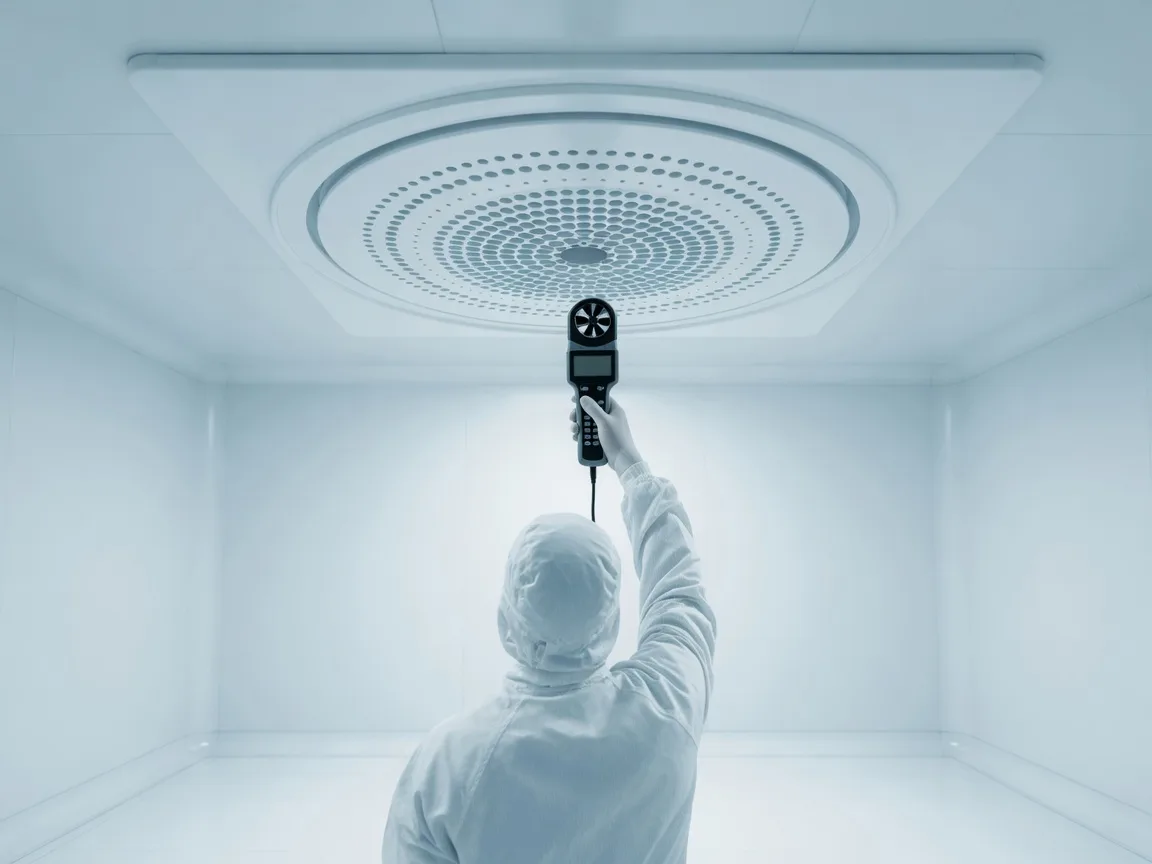
Measurement of airflow rates: airflow velocities are measured with instruments such as anemometers to confirm the design figures are achieved in each area.
Adjustments and corrections: supply and exhaust systems are tuned to correct any imbalance, adjusting damper settings, fan speeds or diffuser configurations.
Differential pressure monitoring: positive or negative pressure differentials between zones are maintained to stop contaminants moving from less clean areas into critical zones.
Smoke studies: airflow patterns are visualised to confirm flow direction and to identify stagnant or uneven zones for correction.
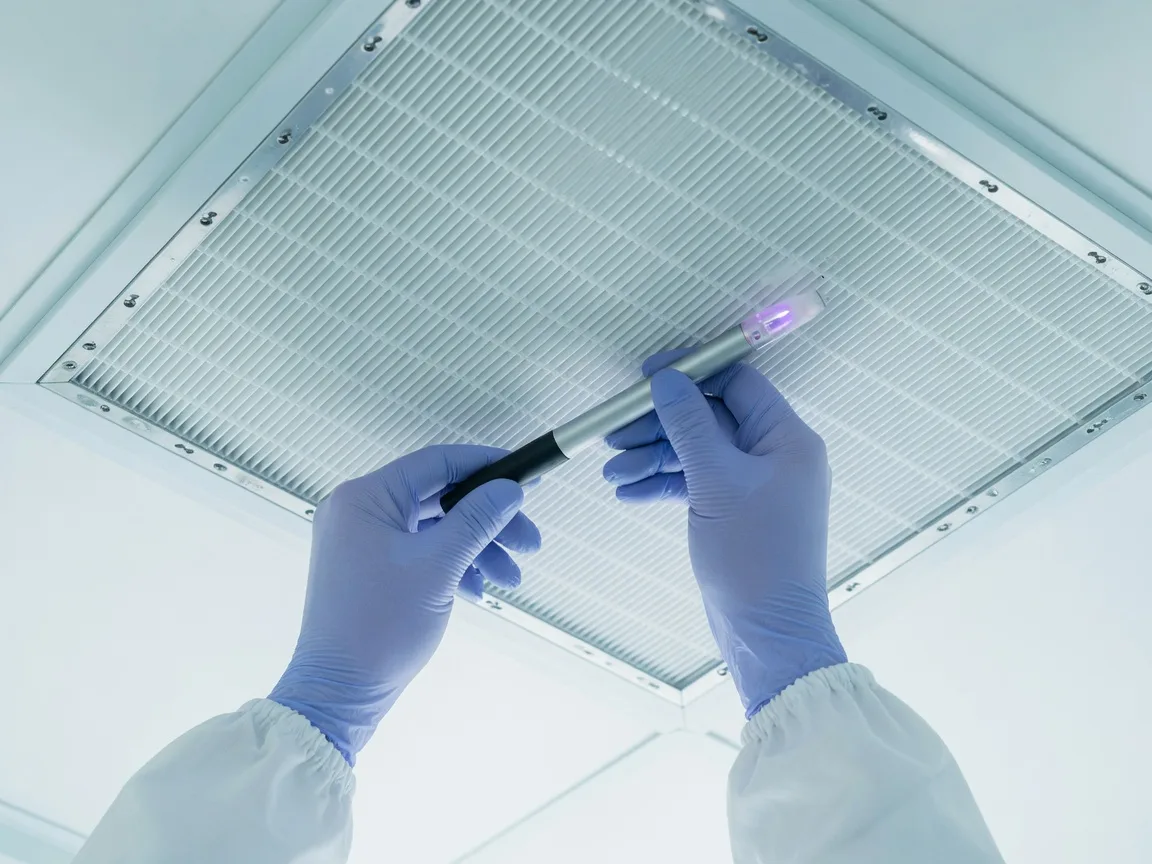
HEPA filter integrity testing: filters are tested to confirm their integrity, as balanced airflow is essential to keep them effective.
Ongoing monitoring: airflow patterns and velocities are checked over time and adjusted as room conditions change.
Compliance with standards: the ventilation system is verified against the relevant standards, such as ISO 14644.
Benefits of proper air balancing
Maintained cleanliness levels: prevents contaminants accumulating so the room holds its cleanliness class.
Energy efficiency: a balanced system runs more efficiently, lowering operating costs.
Audit readiness: demonstrable adherence to ventilation and cleanliness standards keeps the room ready for inspection.
Optimised equipment performance: balanced airflow supports the correct operation of fume hoods, laminar flow benches and similar equipment.
What is cleanroom validation?
Cleanroom validation is the process of assessing and documenting a cleanroom’s performance to confirm it meets predetermined standards for cleanliness and environmental conditions.
Key components of cleanroom validation:
Particle counting measures and verifies the level of airborne particles.
Airflow pattern testing confirms airflow and ventilation across the room.
HEPA/ULPA filter integrity testing validates the air filtration systems.
Microbial monitoring tests for microorganisms to confirm a sterile environment.
Air pressure differentials verify that the pressures between zones prevent contamination.
Temperature and humidity control confirms these are held within the specified ranges.
What is cleanroom commissioning?
Cleanroom commissioning is the systematic process of verifying and documenting that the cleanroom’s design, construction and systems are installed and functioning to specification.
Key components of cleanroom commissioning:
System testing confirms that HVAC, filtration and monitoring systems are operational and integrated.
Performance testing validates performance under dynamic, real-world conditions.
Documentation and reporting record the results and evidence for handover and audit.
User training briefs operators and personnel on the correct use and maintenance of the facility.
Benefits of validation and commissioning
Regulatory compliance meets industry standards, regulatory requirements and Good Manufacturing Practice (GMP) guidelines.
Quality assurance confirms the environment consistently meets its cleanliness and performance standards.
Risk mitigation identifies and resolves issues during validation and commissioning, reducing the risk of operational failures.
If your cleanroom is due for handover, recommissioning or periodic revalidation, arrange a survey and we will confirm exactly where it stands against its cleanliness class.
Frequently asked questions
What is the difference between cleanroom validation and commissioning?
Commissioning proves that the cleanroom’s design, construction and systems have been installed and function to specification, and it normally happens once, at handover or after major works. Validation is the ongoing process of measuring and documenting the room’s performance, through particle counting, airflow testing, filter integrity checks and pressure monitoring, to confirm it meets its predetermined cleanliness class. In practice you need both: commissioning gets the facility to its intended standard, and periodic revalidation proves it is still holding that standard once it is in service.
How often should a cleanroom be revalidated?
The benchmark in ISO 14644-2 is a maximum of twelve months between classification tests for most cleanrooms, and six months for rooms at ISO Class 5 or cleaner. Many operators in GMP environments test more frequently than the standard demands, and you should also revalidate after any significant change: new equipment, an altered layout, filter replacement or work on the ventilation system. Routine monitoring of particle counts and pressure differentials sits alongside the formal revalidation programme rather than replacing it.
How much does cleanroom validation and commissioning cost?
There is no standard price, because the cost depends on the specifics of your facility: the size of the cleanroom and the cleanliness class it has to hold, the number of filters, terminals and test points involved, how accessible the plant and ductwork are, and whether testing has to be scheduled around a live production operation or carried out out of hours. The route we use is straightforward: we carry out a free survey to assess the room against its specification, then give you a fixed written quotation for the full scope before any work is booked.
What does HEPA filter integrity testing involve?
Integrity testing confirms that each HEPA or ULPA filter, together with its housing and seals, is removing particles at its rated efficiency. A challenge aerosol is introduced upstream of the filter and the downstream face is scanned with a photometer or particle counter; a reading above the permitted penetration reveals a leak in the media, the frame or the seal, which is then repaired or the filter replaced and retested. It sits hand in hand with air balancing, because a filter can only perform when the airflow across it is correct, and the results form part of your validation documentation.
Can a cleanroom be validated while it is in use?
Yes. ISO 14644 defines three occupancy states for testing: as-built, with the room empty; at-rest, with equipment installed but no personnel present; and operational, with the room in normal use. Your specification or GMP requirements determine which state each test must be performed in, and operational testing gives the truest picture of everyday performance. Where production cannot stop, we plan the work around your operation, testing zone by zone or outside production hours, so your cleanliness class is proven without disrupting output.
Does the ductwork serving a cleanroom need to be kept clean?
Yes: the room is only as clean as the air delivered into it. Dust, debris or microbial growth inside the supply and extract ductwork loads the terminal filters faster, disturbs the balanced airflow and can undermine the pressure regime your validation depends on. Keeping the distribution system clean is part of holding your cleanliness class between revalidations, so it pays to put it on the same schedule. Our air ventilation and ductwork cleaning service works to BESA TR19 guidance and pairs naturally with a cleanroom validation programme.
What documentation do you receive after validation and commissioning?
Validation and commissioning are evidential processes, so the documented record matters as much as the testing itself. You receive the measured results for every test performed: particle counts against the ISO 14644 class limits, airflow velocities and volumes, pressure differentials, filter integrity results and, where specified, microbial monitoring and temperature and humidity data. The report states clearly whether the room met its specification in each area and is written to stand up to customer audits and GMP inspection. User training on the correct use and maintenance of the facility can also be included at handover.