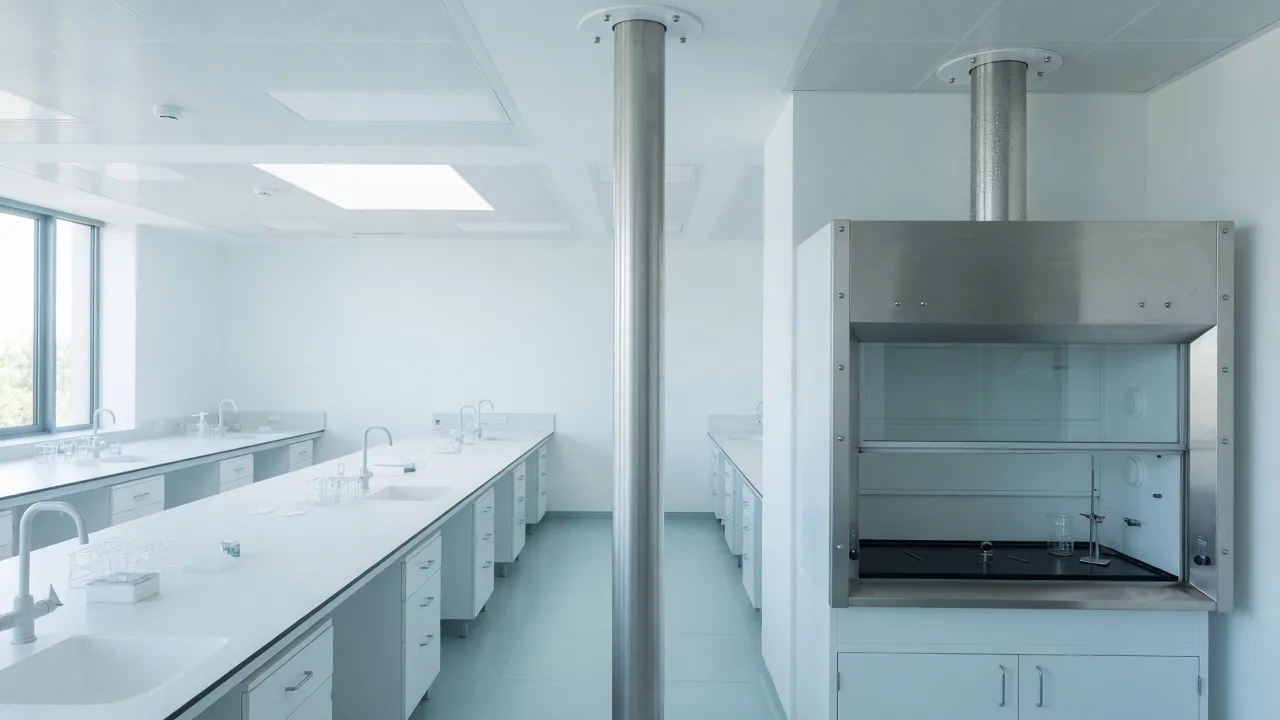
Science facilities Precision environments
Ductwork, Ventilation and Fire Safety Services for Science Facilities
Duct cleaning, AHU servicing, clean-room validation and fire-damper testing for science and research facilities.
Science facilities Precision environments
Duct cleaning, AHU servicing, clean-room validation and fire-damper testing for science and research facilities.
Science facilities depend on controlled airflow, stable ventilation and accurate pressure management. Research labs, instrument rooms, testing spaces and support areas all rely on systems that stay clean, balanced and reliable, because scientific work fails when airflow and contamination control drift away from expected conditions.
Clean Ducts supports universities, biotech firms, pharmaceutical R&D teams, government facilities and private science parks across London and the Home Counties. You receive documented ductwork cleaning, AHU servicing, ventilation validation, clean-room support and fire-damper testing. If your facility includes sensitive research zones or regulated laboratories, schedule full ventilation checks at least every 12 months.
Research buildings combine clean spaces, high-heat zones, chemical rooms and heavily occupied offices, and each area stresses the ventilation system in a different way. Typical challenges include:
Science facilities rely on predictable airflow to protect work, results and staff. Clean Ducts covers scientific sites across London, Hertfordshire, Essex, Kent, Surrey, Berkshire and Buckinghamshire.
Research facilities need duct systems cleaned to protect air quality and keep airflow predictable. Services include:
Clean ducts support consistent airflow, which improves stability in sensitive spaces.
Science buildings include AHUs that feed labs, offices and specialist rooms. We provide:
Even a small drop in airflow can affect instrument calibration and environmental control.
Many science campuses run classified rooms or controlled zones. Services include:
Controlled environments always need more frequent checks than standard offices.
Research labs often rely on localised extraction. Services include:
A weak extract line in a fume-hood system undermines containment.
Science facilities have complex layouts with many compartment lines. We deliver:
Fire dampers protect laboratory corridors and escape routes, and neglecting them creates avoidable risk.
Science facilities rely on documented evidence for every audit, and Clean Ducts provides clear, traceable reports.
Science facilities must meet workplace-ventilation law, fire-safety requirements and any sector-specific compliance standards. Core obligations include:
Scientific work is often audited externally, so complete documentation is essential.
If results drift or instruments show environmental alerts, airflow or pressure issues are early suspects.
Do you work inside active laboratories? Yes. We coordinate with safety teams and follow your lab-access and contamination-control protocols.
Can you validate airflow in controlled and clean rooms? Yes. We measure air-change rates, map pressure cascades and test filtration performance against the required standard.
Can work be scheduled around research activity? Yes. We plan tasks during low-activity periods or controlled shutdowns so live work is not disrupted.
If your facility includes sensitive research zones or regulated laboratories, a ventilation survey confirms whether airflow, filtration and fire protection are performing to specification. Request a survey and we will scope the ductwork, ventilation and fire-damper testing your site needs.
Request a free survey. A named engineer walks the system and puts what’s compliant, and what isn’t, in writing within 24 hours.