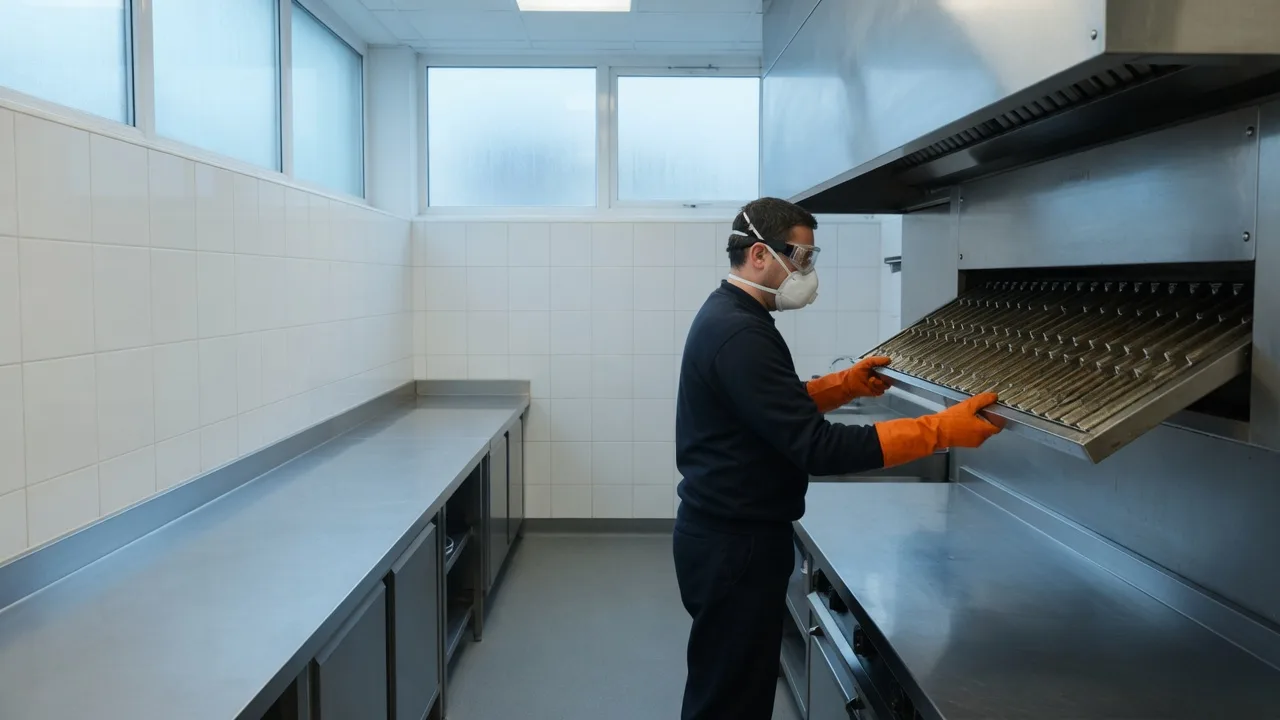
Restaurants Kitchens under load
Ductwork, Kitchen Extract and Ventilation Services for Restaurants
Kitchen-extract cleaning, ventilation support and fire-damper testing for restaurants and hospitality groups.
Restaurants Kitchens under load
Kitchen-extract cleaning, ventilation support and fire-damper testing for restaurants and hospitality groups.
Restaurants depend on strong kitchen-extract systems, clean ductwork and dependable ventilation. Grease, smoke, vapour and heat build up quickly during busy service, and when cleaning and testing slip, airflow drops, fire risk rises and compliance becomes harder to hold. Clean Ducts supports single-site restaurants, national chains, landlords and hospitality groups with documented kitchen-extract cleaning, mechanical ventilation support, AHU maintenance and fire-damper testing.
Grease accumulation inside extract systems is a recognised fire risk, which is why a busy kitchen needs a cleaning schedule set by cooking hours and grease load rather than guesswork.
Restaurant environments generate heavy airborne contaminants. Grease settles inside ductwork, blocks filters and coats fans, and long shifts in busy kitchens amplify the problem. Front-of-house zones also need stable airflow for comfort and compliance. Common challenges include:
Restaurant ventilation problems rarely stay hidden. They spread into the dining space and soon reach your customers. Clean Ducts supports restaurants across London, Hertfordshire, Essex, Kent, Surrey, Berkshire and Buckinghamshire.
This is the core service most restaurants need. You receive:
A clean extract system lowers fire risk and restores airflow, and TR19 Grease cleaning gives you the post-clean evidence insurers expect.
Dining rooms and staff areas need reliable ventilation for temperature control and odour management. We deliver:
Before adjusting controls, check for blocked filters, stuck dampers or clogged ductwork, as these are the usual cause of poor airflow.
Many restaurants overlook the general ventilation ducts outside the kitchen. Services include:
Shared extract risers in multi-tenant buildings should be inspected annually.
Fire safety is essential in busy hospitality buildings. Services include:
Fire dampers in restaurant buildings often sit behind difficult access points, so scheduled testing is the only reliable way to confirm they still operate.
Larger restaurants and hotel venues often include additional spaces. Services include:
Without clear extract-cleaning records, your insurance position weakens the moment a claim is examined.
Restaurants must comply with food-hygiene regulations, workplace-ventilation law and fire-safety standards. Key obligations include:
Local-authority EHO inspections often request extract-cleaning evidence as part of food-hygiene checks, so keep your records current.
If your kitchen feels smoky, the extract system is already underperforming.
How often should my kitchen extract be cleaned? This depends on cooking hours and grease load. Busy restaurants often require cleaning every three to six months, with the interval set by BESA TR19 Grease risk classification.
Do you work overnight? Yes. Most restaurant jobs take place after service or before opening to avoid disrupting trade.
Can you install access panels for compliance? Yes. Many systems need added access points so the full run of ductwork can be inspected and cleaned to standard.
If your extract system does not have a clear cleaning schedule, a survey confirms grease load, airflow and fire-damper status and sets the right cleaning interval. Request a survey and we will scope the kitchen-extract, ventilation and fire-damper testing your restaurant needs.
Request a free survey. A named engineer walks the system and puts what’s compliant, and what isn’t, in writing within 24 hours.