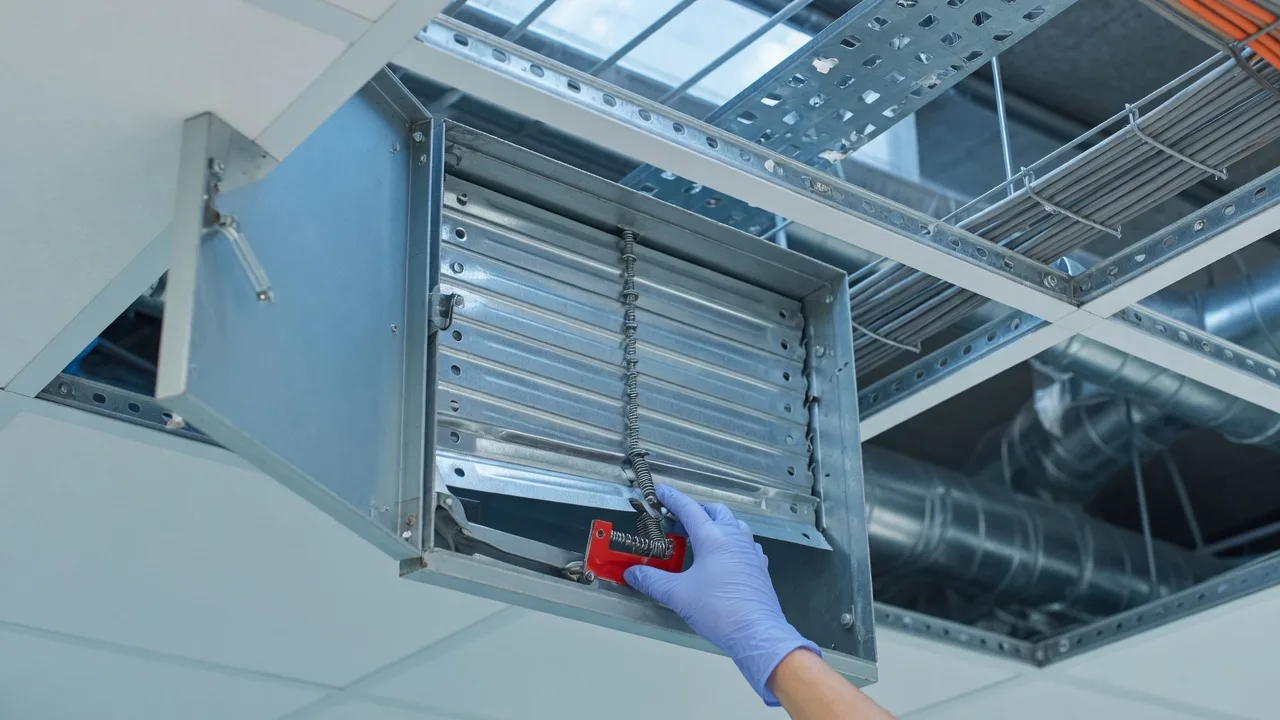
Fire dampers sit inside your building’s ductwork and rarely get a second thought, yet they are a life-safety device that should form a key part of your fire strategy. When a fire starts, they close to stop fire and smoke travelling through the ventilation system from one compartment to the next.
What are fire dampers?
Fire dampers are found in HVAC (heating, ventilation and air conditioning) systems and ductwork, where they prevent the spread of fire and smoke inside the ducts that pass through a building.
Ductwork routinely passes through fire zones and fire-resistant rated walls and floors. You need fire dampers at these points so that fire cannot pass from one floor to another, or from room to room, through the ductwork. Fire and smoke dampers also stop smoke moving inside the ducts, which is what accounts for most casualties in a building fire.
How do fire dampers work?
Most fire dampers are triggered by a thermal element or fusible link that melts at a set temperature, above the normal operating range, when a fire is present. When the temperature rises and the link melts, the fire damper, an internal metal curtain within the ductwork, closes.
The damper is spring-loaded to drop quickly, and its interlocking metal blades form an airtight metal shield inside the duct. This compartmentalises the affected area and buys the people in your building valuable time to escape the smoke and fire, and firefighters time to reach the affected areas, before temperatures exceed the fire rating of the damper itself.
Automatic fire dampers linked into a building management system or fire alarm can also close on a signal from that central system.
How often should fire dampers be tested?
Under the British Standard code of practice BS 9999:2017, spring-operated fire dampers should be tested at least annually. Fire dampers situated in dust-laden ductwork and similarly dusty environments should be tested more frequently to confirm they can still fully function and close.
Testing at regular intervals is also a legal requirement under the Regulatory Reform (Fire Safety) Order 2005, in line with the guidance on fire safety in the design, management and use of buildings set out in BS 9999:2017. The duty holder for the premises is responsible for making sure this happens.
Where are fire dampers located?
Fire dampers sit within the ventilation system at the intersection points (walls and partitions) where ductwork passes through fire compartments.
Because they are part of a building’s internal fabric, they can be hard to locate and access. That is exactly where fire safety problems arise: dampers that have been left out of a regular inspection and testing regime, or that were never recorded, may fail to close when it matters.
Testing and reporting on your fire dampers
Our ventilation technicians are trained through BESA’s ventilation programmes and are experienced in fire damper maintenance. Clean Ducts is a BESCA Vent Hygiene Associate member, and we test and report on your fire dampers in accordance with HTM 03-01 and BS 9999:2017.
Every report gives you a clear compliance record:
- Each damper is logged as an individual asset
- The asset is labelled and photographed as evidence of its ability to open and close
- Any defects or issues, including inaccessibility, are recorded so they can be addressed and rectified
- The full set of records is provided for your fire safety file
The result is a documented, defensible position that shows your dampers have been inspected and are able to perform in the event of a fire.
If you are unsure when your fire dampers were last tested, or whether every damper in your building has been located and recorded, request a survey and we will assess your system and set out what compliance requires.